
Quantitative Analysis of English Literature from 1395 (Chaucer) to 2015 (Bowen)
Published December 11, 2025
https://doi.org/10.23999/j.lcsm.2025.4
Linguistic Cues to Social Meaning 5, December 2025, 100012.
Under a Creative Commons license
HOW TO CITE THIS ARTICLE (APA STYLE)
Fesenko, I. P. (2025). Quantitative analysis of English literature from 1395 (Chaucer) to 2015 (Bowen). Linguistic Cues to Social Meaning, 5, Article 100012.

ABSTRACT
Correlation between transition in the English language to dominantly plural addressing and the social stabilization in England is estimated. The time dependence of calculated plural addressing a person in the English literature shows saturation value of 1.00 already in XIX century.
KEYWORDS
English literature, addressing number, singular, plural, social stabilization
INTRODUCTION
Counting a sum of singular and plural addressing in a text gives the possibility to estimate a tendency of using plural addressing (pluralis maiestaticus) as a dignifying aspect of the communication. The aim of this paper is to analyze the tendency of using plural addressing a person in the English literature.
Experimental
Number of addressing a person in a communication sentence is determined by the number of an addressing noun/name and/or a verb. One sentence may contain one or more addressing both singular and plural. Counting them in a text is illustrated in the examples:
Singular addressing a person:
- Professor, are thou drinking coffee? (One singular addressing)
Plural addressing a person:
- Professor, are you drinking tea? (One plural addressing)
- Professor, you are drinking tea, aren’t you? (Two plural addressing)
When there is no subject of addressing in a sentence, and a verb is in plural or singular form, we take it as an addressing a reader and count it respectfully as plural or singular:
You will remember, if you have read the tales in the first Jungle Book,… (R. Kipling) (two plural addressing)
Results and Discussion
Singular and plural number of addressing have been counted in the texts of the English literature from G. Chaucer to R. Bowen [1-15] and presented in the Data Base of Plural Addressing a Person [16].
The results as a total sum of singular and plural addressing, as well as calculated content of plural addressing a person in the text, show an evolutionary rise and saturation (Fig 1).
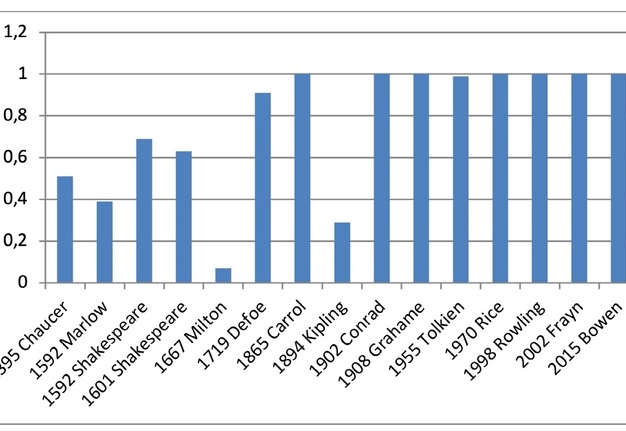
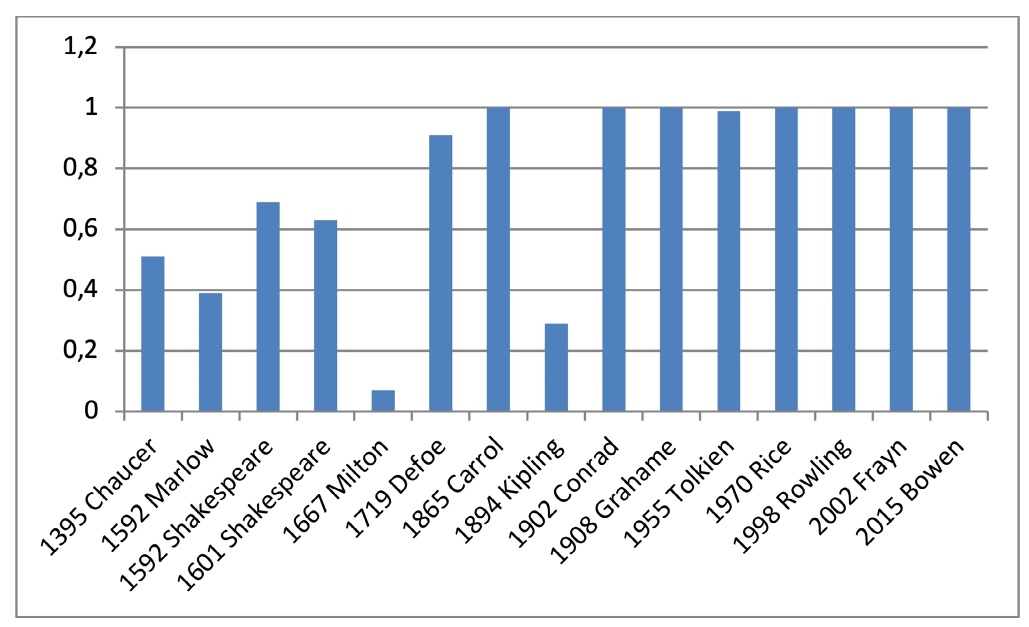
FIGURE 1. Content of plural addressing a person in texts of the English literature.
Two exceptions of this tendency are observed – Paradise Lost by J. Milton (1667) and Mowgli by R. Kipling (1894). Paradise Lost by J. Milton has very low content of plural addressing a person what correlates with a social position of the author being a defender of the killing of Charles I. Mowgli by R. Kipling (1894) has a relatively low content of plural addressing and may be explained by the fact that the author was trying to give a view of communication reality in India with its native tongues and mostly common singular addressing.
Prof. M. Schlauch [17] suggested a correlation between a transition from singular to plural addressing a person in the English language accomplished circa 1700 and the social stabilization in England. Indeed, after 1700 the killings, for example, members of the royal families have been ceased. The last queen assassinated by the English society was Maria Stuart in 1587, and the king – Charles I in 1649.
CONCLUSIONS
For the first time, the proposed by Prof. M. Schlauch correlation between the social stabilization in England and a transition in the English language to dominantly plural addressing is estimated quantitatively. The time dependence of plural addressing a person in the English literature shows saturation value of 1.00 already in XIX century.
REFERENCES (17)
- Chaucer, G. (2011). The Canterbury Tales. Collins Classics. Harper Press.
- Shakespeare, W. (2004). The Taming of the Shrew. Wordsworth Classics. Wordsworth Editions.
- Shakespeare, W. (1988). Twelfth Night or What You Will. Bantam Books.
- Marlow, Ch. (2009). The Tragical History of Doctor Faustus. From the Quarto of 1604. Rev. by Alexander Dyce (Ed.). Project Gutenberg EBOOK.
- Milton, J. (1994). The English Poems. Paradise Lost (pp. 125-412), Paradise Regained (pp. 413-472). Wordsworth Poetry Library.
- Defoe, D. (1994). Robinson Crusoe. Penguin books.
- Carroll, L. (1992). Alice’s Adventures. Raduga.
- Grahame, K. (1994). The Wind in the Willows. Penguin Popular Classics.
- Conrad, J. (2014). Heart of Darkness. Dover thrift editions.
- Kipling, R. (2015). Mowgli. Folio.
- Tolkien, JRR. (2002). The Lord of the Rings. The Fellowship of the Ring. (Book I, Volume 2, ch.6-12). Rolf.
- Rice, T. Jesus Christ Superstar. Internet.
- Rowling, J. K. (1998). Harry Potter and the Chamber of Secrets. Raincoast Books.
- Frayn, M. (2002). Spies. Faber and Faber.
- Bowen, R. (2015). Malice at the Palace. Penguin Random House LLC.
- Fesenko, I. P., & Chasnyk, V. I. (2025). Data base of plural addressing a person. Linguistic Cues to Social Meaning, 5, Article 100011. https://doi.org/10.23999/j.lcsm.2025.3
- Schlauch, M. (1976). The English Language in Modern Times (since 1400). Państwowe Wydawnictwo Naukowe.