
Data Base of Addressing a Person in World Literature Shows a Key to Social Stabilization
Published December 09, 2025
https://doi.org/10.23999/j.lcsm.2025.1
Linguistic Cues to Social Meaning 5, December 2025, 1–2.
Under a Creative Commons license
HOW TO CITE THIS ARTICLE (APA STYLE)
Fesenko, I. P. (2025). Data base of addressing a person in world literature shows a key to social stabilization. Linguistic Cues to Social Meaning, 5, Article 100009.

ARTICLE
This volume of the Linguistic Cues to Social Meaning continues study of addressing number to a single person in public space with the aim to minimize the connected social risks.
The first article is exactly a Letter to the Editor having been applied to the Nature in 2009 presenting historical and geographical peculiarities of Transition from Singular to Plural Form in Single-Person Addressing [1].
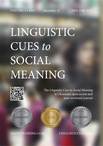
The second article of the Volume presents a Data Base of Plural Addressing a Person in works of the world literature, calculated by FESENKO.LAB and CHASNYK.LAB, enriched since the monograph of 2018 (Fig 1) [2].


FIGURE 1. Cover page of the monograph titled “Transition from Singular to Plural Form in Single-Person Addressing in Literature and Mass Media” (1st edition, 2018) [2].
Besides, this Volume contains in the third article – the quantitative analysis of 15 texts of the English literature since Chaucer’s time to the XXI century in terms of addressing number. It illustrates gradual growing and achieving saturation – dominant use of plural addressing in the English language in parallel with a social stabilization. A preliminary comment of the analysis of Data Base of Plural Addressing a Person in the French literature you will find in the fourth article.
The Editorial Board invites readers and authors to quantitative analysis in their native communication area, i.e. strict counting of plural and singular addressing in their native literature seeking for trends and tendencies.
GENERATIVE AI STATEMENT
The author(s) declare that no Generative AI was used in the creation of this manuscript.
REFERENCES (2)
- Fesenko, I. P. (2009) Nature of transition from singular to plural form in single-person addressing [Unpublished manuscript: Nature manuscript ID 2009–4–03926 (PDF EJP-10_150340_13649)]. National Academy of Sciences of Ukraine.
- Fesenko, I. P., Fesenko, O. D., & Chasnyk, V. I. (2018) Transition from singular to plural form in single-person addressing in literature and mass media (1st ed.). FOP Maydachenko I. V.